

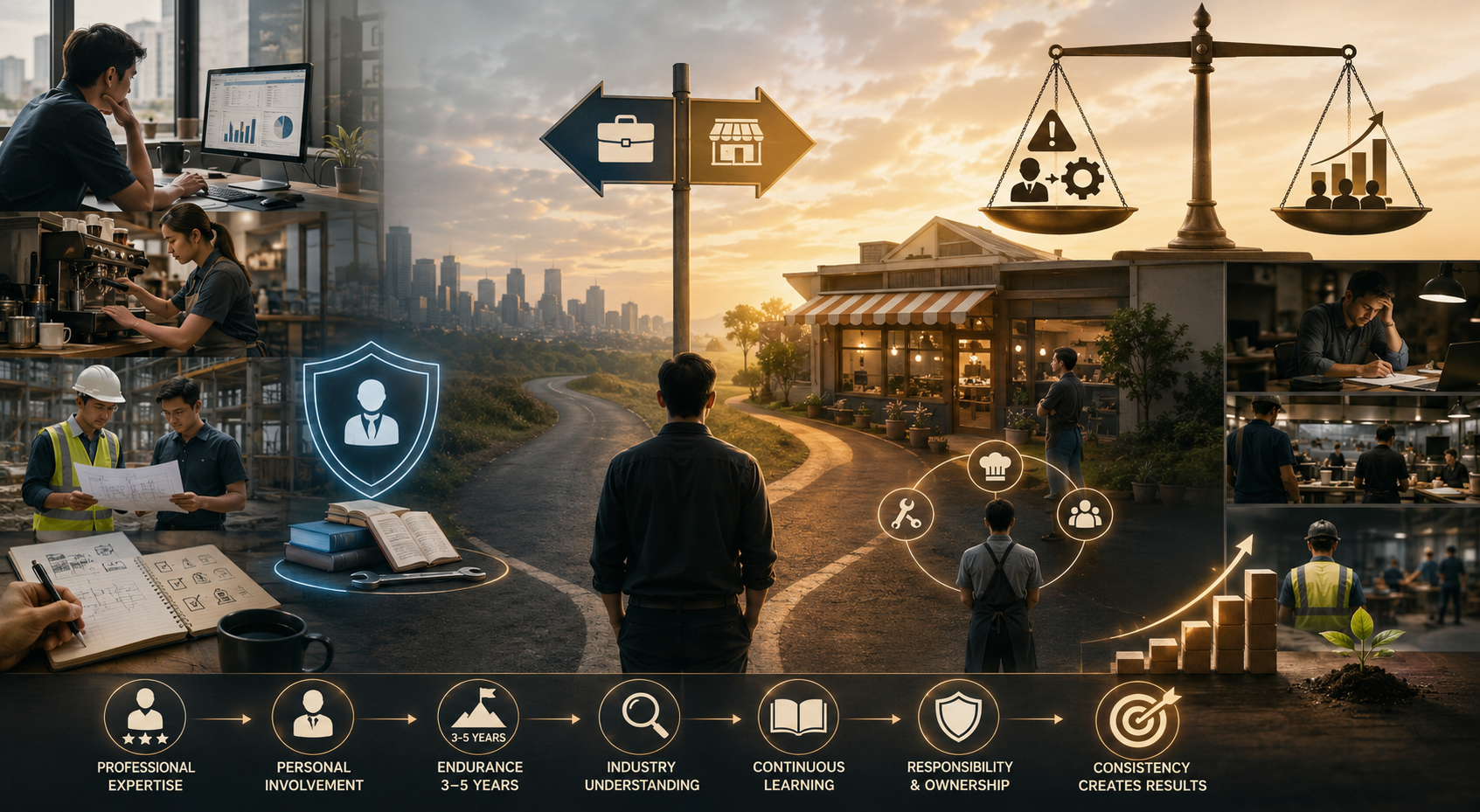

In mature markets like Australia, small business ownership is not fundamentally a “scale game” — it is about turning professional capability into commercial value.
When you possess a specialised skill, the primary risk you take on in business is operational and commercial risk.
But when you enter an industry without any real expertise, you are taking on two layers of risk at the same time: industry risk and management risk.
The difficulty level between the two is completely different.
Many first-time buyers feel anxious because they see entrepreneurship as a form of status transition.
Moving from employee to business owner appears, on the surface, to be an upgrade.
But in reality, entrepreneurship is not an upgrade — it is an amplifier.
Your strengths become more visible, but so do your weaknesses.
Your patience is constantly tested.
Your emotions are magnified under pressure.
Your professional ability is challenged, and your blind spots are exposed very quickly.
This is exactly why the advice to “work in the industry first” keeps coming up repeatedly.
Employment is essentially a low-cost testing model.
Spend three months working as a barista, for example, and you will quickly discover:
Can you genuinely handle early mornings?
Can you cope with peak-hour pressure?
Do you actually enjoy dealing with customers every day?
These are things no financial statement can tell you.
Looking at it more deeply, in mature economies, long-term business returns rarely come from chasing trends or “hot opportunities.”
They come from consistency.
Doing the same thing well, every single day.
Keeping costs under control.
Maintaining service quality.
Building strong customer relationships over time.
It sounds ordinary, but this is where sustainable profit is created.
And this is where skills become so important — they make consistency controllable.
If you cannot cook, kitchen quality becomes unstable.
If you do not understand construction, you cannot properly judge workmanship.
If you lack technical knowledge, managing technical staff becomes extremely difficult.
The moment you lose the ability to evaluate and guide the work itself, you lose control.
At its core, entrepreneurship is about gaining control over outcomes.
And professional capability is at the centre of that control.
So it is important to say this clearly and honestly:
Entrepreneurship is not suitable for everyone.
It is generally better suited to three types of people:
People with genuine professional expertise.
People willing to stay personally involved in the business.
People capable of enduring three to five years of sustained pressure and uncertainty.
Ideally, a business owner possesses all three.
If someone has no practical skills yet hopes to become a “hands-off boss,” the risks become extremely high in a country like Australia where labour costs are significant and staffing challenges are constant.
On the other hand, if someone:
Understands the industry
Is willing to work hard
Is committed to learning
Is prepared to take responsibility
then even in weaker market conditions, they can still create opportunities through efficiency, reliability, and operational stability.
Because in mature markets, competition is often not about who is the smartest.
It is about who can remain the most consistent.
Many people think entrepreneurship is mainly about timing or opportunity.
In reality, it is more about alignment.
When capability, industry choice, personality, and financial reserves align, entrepreneurship becomes a rational decision.
When they do not align, even the best market timing will not save the business.
That is why the goal is not simply to encourage or discourage buyers, but to give them a framework for judgement.
The real question is not:
“Is the market good right now?”
The real question is:
“Am I truly prepared?”
Markets will always move in cycles.
Capability is what allows people to survive through those cycles.

